Saturday, 14 March 2015

The Chellah


The Chellah is a short taxi ride out of central Rabat. It is the original settlement form Roman times.It was re-fortified by the Merenids and now comprises three separate parts in what is really a park with attractive wilderness gardens and views over to Sale.


The whole is enclosed in the Merenid walls and the view of these and the Rabat town walls with the very modern barracks building behind makes a startling contrast. 


The gardens make a pleasant break from the town and a worth a visit in themselves but but if you are lucky enough to visit in spring, as we did, what makes it truly magical are the 79 pairs of nesting white storks and the flocks of white egrets. 


Thursday, 12 March 2015

The Tour Hassan and the Mohammed V Mausoleum


In the 1190s El Mansour decided to rebuild Rabat with a great new mosque as it's centrepiece. If it had been completed it would have been the second largest in the muslim world after Smarra in Iraq. The project was abandoned at his death and the earthquake of 1745 brought down the roof  so that it is now a ruin. However the uncompleted tower is important as one of the few surviving example of Almohad achitecture and is contemporaneous with the Koutoubia in Marrakesh and the Giralda in Seville.


The site however has an emotional significance for moroccans and was hence chosen as the site for the mausoleum of Mohammed V who, of course, was the restored monarch after the  protectorate and therefore symbolic of the independent nation. subsequently his sons Hassan II and Moulay Abdellah were also buried there.


 The mosque in his memory is closed but the mausoleum is open to the public of whatever faith. It is , in my view, an extremely successful example of modern prestige moroccan architecture, although, strangely, designed by a vietnamese architect.


The entrance to the site is guarded by resplendently uniformed horseguards.


 We decided they were not quite as awe-inspiring as those at Horseguards in London as  the horses were more fidgety, but when we got in found that this was really a cultural difference as the sentries at each door actively moved to smile and assist in the taking of pictures with the visitors, unlike in London where the challenge is to feign complete indifference and maintain a non-smiling forward blank demeanour. 


There are further infantrymen inside at the four corners of the building and an iman reciting the Q'ran continuously.


Tuesday, 10 March 2015

The Andalusian Gardens and the Jewellery Museum


The Oudaya was one of Moulay Ismael's smaller palaces.(He who built at Meknes to rival Versailles.) He subdued the pirate Republic in Sale and took over the Rabat Kasbah to keep them subdued. It was garrisoned by Sahari warriors who accepted military service in lieu of paying taxes. 
There is a nice garden courtyard, replanted by the French as the "Andalusian Gardens" and the palace itself is now a jewellery museum. This is a little confusing as there are a lot of non-jewellery items in various books labelled as belonging to the  "Oudaya Museum Rabat" which were presumably there in a previous incarnation. They now appear to be physically in the Archaeological Museum although they are still labelled as belonging to the Oudaya. 
The Archaeological Museum itself is probably the best 80p you'll spend to visit a museum anywhere. It is very small but has some outstanding Bronzes and some greek-style stone carvings from the roman period to say nothing of a couple of neolithic skeletons. Sadly they do not allow you to take pictures. 


Sunday, 8 March 2015

The Semaphore Station


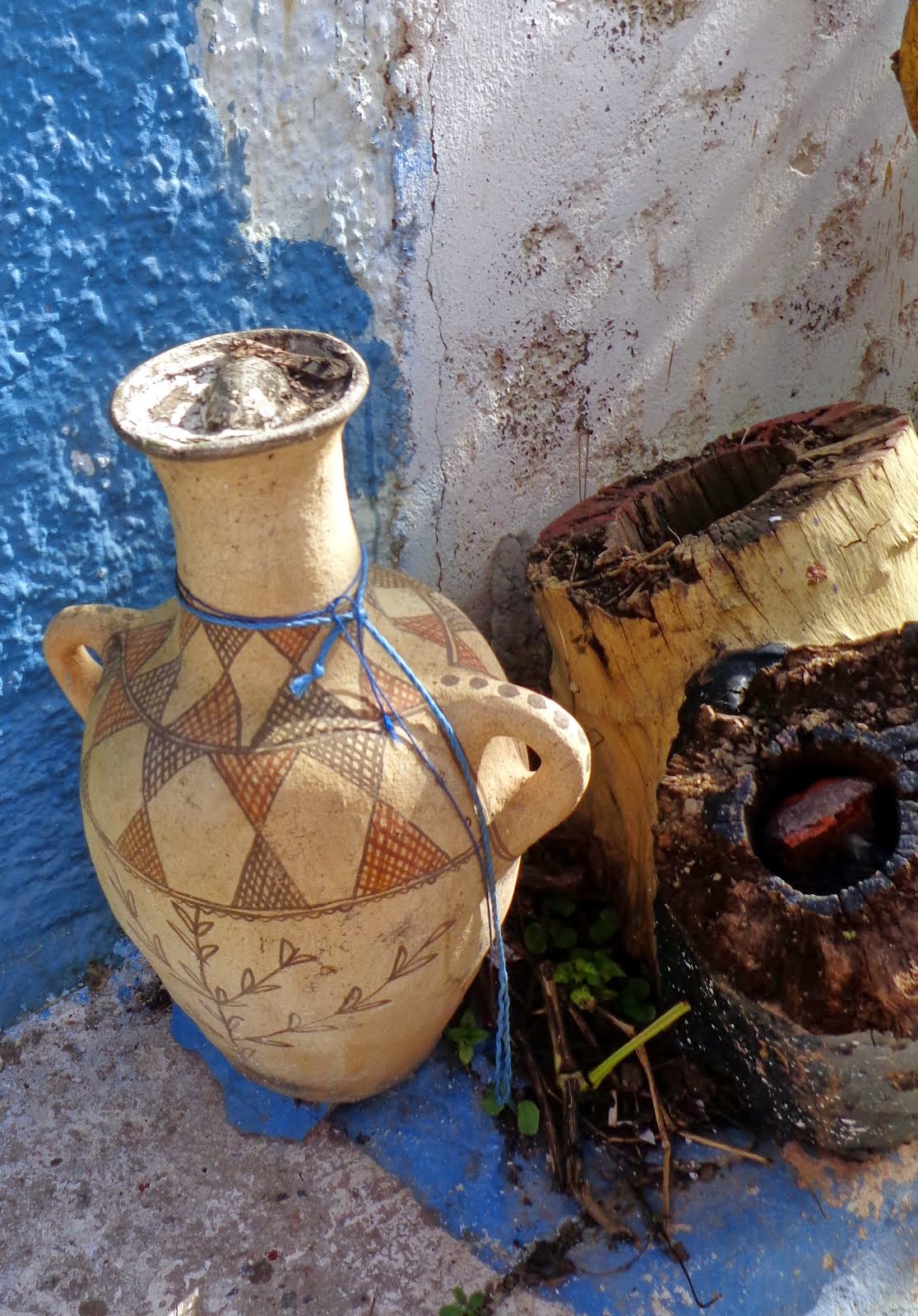
 Once through the gate narrow attractive streets with blue paint reminiscent of Greece lead you down to the 17C platforme built as a semaphore station.


 It has panoramic views over the estuary and across to Sale on the north bank of the Bouregreg.


 One of the streets had a shop selling women's pottery. In the towns men made pottery industrially and usually glazed. In the country women made pottery, unglazed and low-fired although decorated with simple coloured patterns.


There is a sandbank at the mouth of the river and the wreckers used to entice merchant ships in (the local pirate ships and fishing boats were shallow-keeled) so that the grounded on the sandbank within range of the cannon from the Kasbah forts.


Kasbah Ouadaya


Rabat is named after the ribit or fortified monastery built there in the 11C to defend against expected Norman attacks which did not materialise. Now all that is left of the ribit are a few  archaeological remains.


The later Kasbah was built on the same site,a raised promontary controlling both the sea approaches and the entrance to the Bouregreg river. In 1195 Yacoub el Mansour inserted a great monumental gate into the walls. It is really impressive Almohad architecture with darj w ktarf patterning.


North to Rabat


We're just back from a trip to Rabat. To get there take the motorway and keep going after Marrakesh. I've always found that central plain all very boring, flat and endless. Apparently nobody much lived there until the last century; It needs irrigation to farm and so people chose  to live in defensible site in the hills. It seemed like spring though. They'd had a lot of rain the week before and the verges and pasture had lots of flowers. There was a particularly striking orange one growing in the grazing ares. As these are dotted between crops and so from a distance you'd see a field of bright orange the way you see a bright yellow field of rape in Britain.


 The grazing was for cows as well as sheep which answers my question as to where the milk comes from. you never see cows near Taroudant.  
When you get to Rabat the city has some nice Art Deco building from the Protectorate.


Rabat Ville Station


The Telephone Company


Parliament Building
There was a small demo outside the Parliament, only a dozen or so people standing in a circle. The noise they made chanting/singing was impressive. It would not have been allowed in London.


Thursday, 5 March 2015

The Koranic Schools and the Watchers

Before coming up north on a road trip and therefore not blogging I posted  a blog "The Koranic Schools". The next day I had 336 views which is about 300 more than usual. All were on Linux, (most views are on Windows or Android), were from Morocco, the UK and USA, and were distributed between all the blog posts. It's not as though my recipe for banana muffins had suddenly gone viral. Had the term "Koranic School" emanating from Morocco tripped an Edward Snowden programme?  Presumably, if so,the hits were entirely electronic as it would only take a human half a dozen posts to realise this blog is written by an old woman interested in plants, needlepoint and tourism. But if it was the watchers why did they leave Linux footprints all over me? I thought the purpose of the watchers was not to let you know you were watched. I'm getting old, modern life is confusing.