Friday, 20 November 2015

A moussem in Chechaouen


On our first evening in Chefchaouen we were wandering up to the Outa el Hamman when we heard a commotion behind us. There were a lot of drums and those reedy pipes that usually signify a wedding but it wasn't a Thursday. We realised that there was a small procession led by three older men carrying flags,


 followed by the band and with a number of elderly men brandishing old fashioned wooden stock rifles/muskets?? (they ram loaded down the barrel). 


They were accompagnied by a crowd of women, children and young men and turned into the square stopping in front of the mosque. The followers crowded onto the steps in front of the mosque to get the best view and quite a crowd of excited locals gathered around them.


The flags were furled and carried into the mosque and the rifle carriers proceeded to march round in a circle. one unarmed old guy sat in the centre and they followed him in a sort of lead and response chant. 


This built up in intensity and just when it was getting a bit boring the surprised everyone by firing their guns causing a collective jump. There was a bit of a gap whilst the musicians started up again and they reloaded and then they started circling again, lead and response, with everyone holding up their rifle except for one old guy who was walking round with his on his head.


 They built up to another firing and just as the shots ricocheted around the square the rain started, exactly as if it had been a rain dance, not that you need one in Chef, and everybody hurriedly dispersed and went for cover.
We never found out what it was about..


However when we passed the mosque at the other end of the square after sunset the next day it was open with a number of equally old men sitting singing chants similar to the Sufi led celebrations occasionally heard in Taroudant. Cound these be one of the Brotherhoods for which the Rif is famous. Everyone takeing part was old 70+ I'd say. The young men just watched excitedly and took pictures on their phones.

Sunday, 15 November 2015

Chefchaouen


We first went to Chefchaouen 25 years ago and I remember a sleepy little blue town with steps for streets  and the guide proudly telling us that they had a population of 35,000 and water to double that.


If you look very hard on the steeper back streets you can still find that Chefchaouen today but the main square and the area around it are now are continuous strips of cafes, B&Bs and stalls selling ubiquitous tourist crap.I expect in the summer the tourist population is nearly 35,000. Still the traditional houses are attractive. As well as having the blue windows and doors traditional in northern Morocco the Chefchaoueni colour their whitewash with blue so the walls are a paler blue. Add the stepped lanes and a couple of potted plants and the postcard and fridge magnet printers are in business.


Despite the touristic melee of the Outa el Hamman the Kasbah (entrance 10DH) entered from it is a neglected area well restored and preserved by the state agencies based there, with a display of local craft techniques and a most beautiful garden.


It was sowering during our visit, (everyone in Chefchaouen carries an umbrella in autumn), so I stayed in the jail out of the rain and contemplating the planting whilst Beloved went up the tower.


 The view from the tower is, naturally, outstanding. 


The Kasbah was built in 1471 by Moulay Ali Ben Musa Ben Rashid when he founded the town fleeing from the Reconquista. The town was therefore originally populated by indigenous tribesmen but muslims and sephardic jews fleeing Spain.


Thursday, 12 November 2015

The Rif


The Rif appears to be a northern extrusion of the middle atlas but is in fact not geologically related to the Atlas system at all but to the mountains of southern Spain.It has a high rainfall and isvery green , more like Wales.
 It has always been a very independant area, the population,of Chleugh mixed with muslim and jewish refugees from the reconquista, speak an Amizigh language (though not the Tashalet of Taroudant) and resisted the Spanish Protectorate, forming a self-declared republic in 1921 which survived until 1925, nearly beating the Spanish who only defeated it with the help of the French and the widespread use of mustard gas. Cancer rates in the area are elevated to this day.
The area is traditionally controlled by various muslim brotherhoods, one of the largest of which has its zaouia in Ouezzine. Further north around Ketama (now Issaguen) the traditional crop is cannabis, which was actively encouraged by the Spanish during the occupation. Cultivation remained legal until the 1970s, and despite it becoming illegal and attempts to suppress it 2011 figures showed that 72% of all cannabis seizures world-wide originated in the Rif. Despite this the farmers remain poor and the area in need of development.

 http://www.middle-east-online.com/english/?id=59037

The Rif remains fiercely independant and resisted the moroccan government in 1956 having to be ruthlessly put down by Mohammed V's government and there are still calls for an independant Rif Republic based on the 1925 boundaries.

  http://rif.livenations.net/  


Sunday, 8 November 2015

40th Anniversary of the Green March

Friday was the 40th Anniversary of the Green March when Morocco claimed back Western Sahara from the Spanish, utilising the political uncertainty in Spain as Franco was in his last illness.
The Anniversary is always a National Holiday and this year being the 40th rather more was made of it. As it also fell on a Friday the celebrations spread over a long weekend. Kong Mohammed VI went to Laayoune for the event and a celebration football match was held with various international stars including Marodona, George Weah, Mustapha Hadji and Francesco Toldo.
 The King's speech which is always broadcast at 8.30pm ws delayed by 2 hours causing some concern. In it he ruled out further compromise beyond the offer of administration as an automonous region; confirmed that revenues from the region would continue to listed there, setting out current planned projects, including a desalination plant; and lashed out at Algeria for not doing more for the refugees in Tindouf. It is the general opinion here that the Algerian Generals take Western money to support the refugees and then divert the Aid for their own benefit.
Meanwhile Morocco has declared the UN special envoy Christopher Ross persona non grata in the Western Sahara and insist he meets only with officials in Rabat. 30,000 Saharwis  demonstrated outside the MINURSO Headquarters for them to leave. (MINURSO is the UN Agency charged with organising the self-determination referendum.)
Here in Taroudant there was a "festival" near the Governors Palace. We did not attend but saw flag bedecked lorries ferrying in hundreds of small boys.They could be heard chanting . It was in arabic so we've no idea what they were saying but could have joined in because the rhythm was exactly that of 1970s demo chants of "The people united will never be defeated.

Friday, 6 November 2015

Tetouan


When the French instigated the "Protectorate" they ceded the northern coastal strip of the country to Spain. Tangier the largest city was an international zone and Ceuta and Melilla the two coastal ports occupied by Spain from the 15C and 16C respectively were marginal so Spain ran their protectorate from Tetouan. Consequently it has some attractive, if Fascist,  colonial architecture.


 Spain nearly lost their territory due to spirited resistance from the Rif and it was only in 1925 with help from French forces that they were finally able to subjugate the region. It must therefore have seemed an attractive proposition to spanish moroccan troops to rebel against the spanish government. That is how Francisco Franco came to announce his rebellion against the elected Spanish Republican Government in Tetouan  and to invade
southern bringing about the Spanish Civil War.
We arrived in Tetouan on a day that was not only market day but when the King was in town. Between an unknown one-way system in the medina, stalls spilling into all the streets and road closures and security barriers in case his Maj should wish to leave the Palace, parking was a complete nightmare. Hurrah for faux-guides I say. 
But the town was looking good for the King.


Sunday, 1 November 2015

Tangiers


We first visited Tangiers 25 years ago with sweetheart and both grannies. It was a Thomson package for half term and time was spent round the pool and beach and finding camel rides and other "family quality time" matters.  
Tangiers seems now to be 3 or 4 times the size. 
The centre is much the same. The Cinema Rif on the Grand Socco was showing a season of motorcycle road movies. I could only think of "The Motorcycle Diaries" and "Easy Rider" but presumably there must be others and in French. The was small demonstration marched in and stood chanting outside the building next to it but we couldn't work out what it was about. 


The Cafe de Paris was as ever it's exquisite Deco interior intact and the elderly clientele could have been the same people as when we were last there, just aged a bit like us.
We walked through the Petit Socco where William Burroughs used to cruse the cafes when Tangier was an international Freeport and every house down there was a brothel or opium den or both. Ginsberg and the Beats used to hang out there in the early 50s and it lives of its reputation although the area is largely cleaned up and just your usual tourist trap now.
We walked down the steps next to the El Minzah  where Churchill used to go to paint, and went down to the port. 


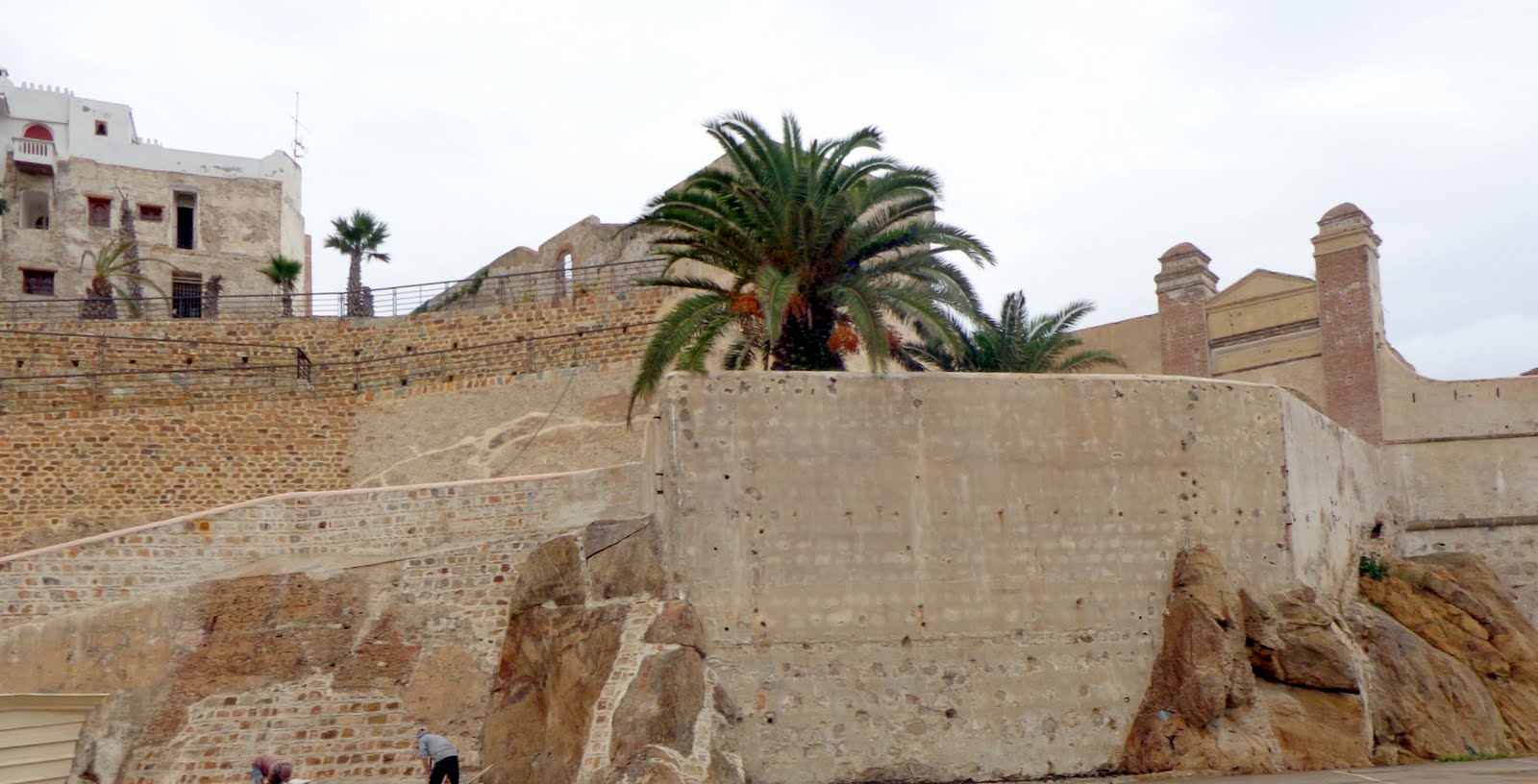
The colonial frontage is still there with cafes and hotels aging a la Haversham  but the big change is that the Ferry port has left. It has moved 20 miles down the coast tto Tangier Med.  It's site is going to be used for a "pleasure port" or marina. 


It will be very upmarket and as the taxi driver said "now is the time to be getting a business in there, it will be very exclusive but people don't think about it now because it's not built". It's not just tourist apartments they sell off plan here.
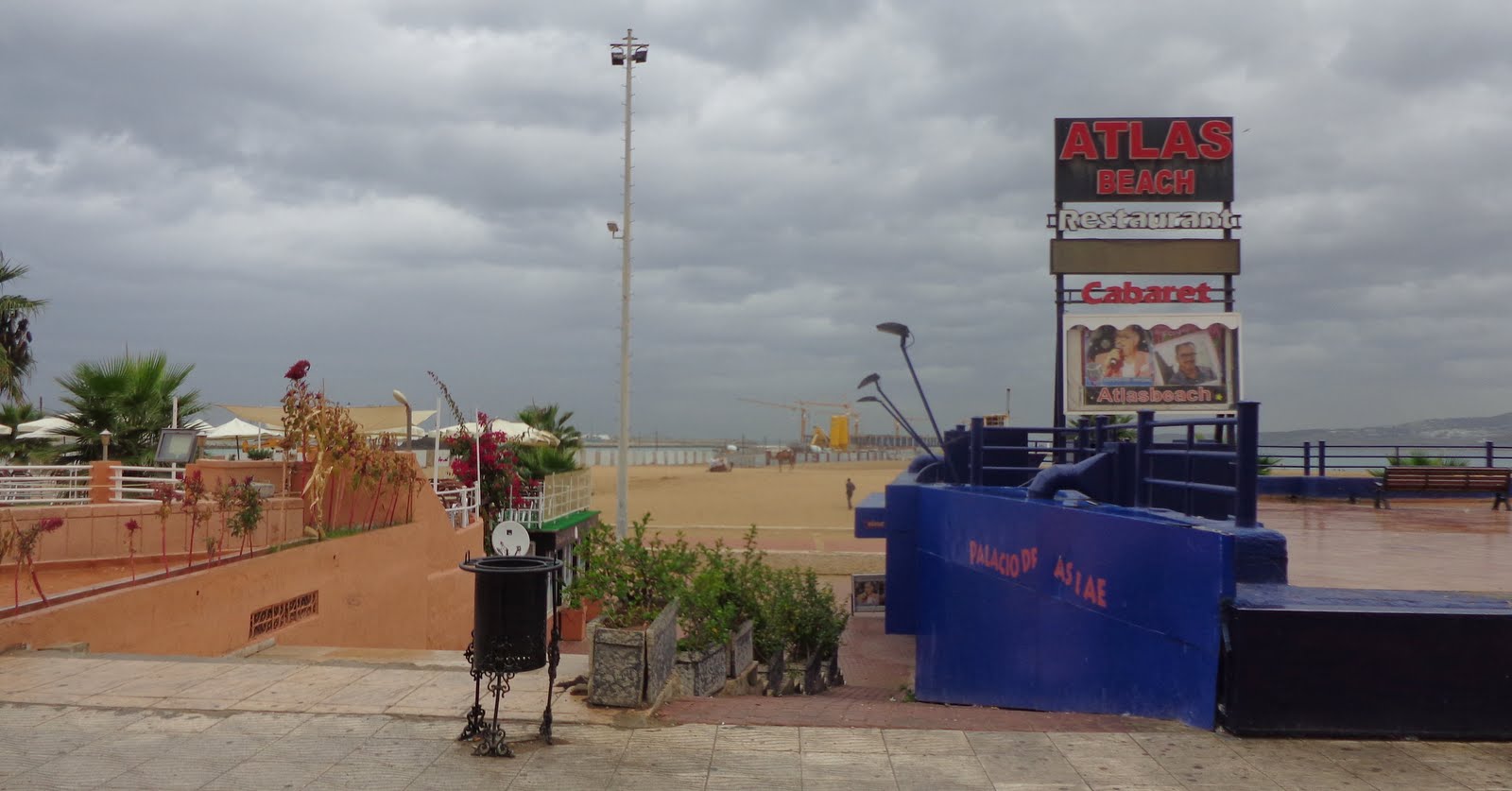
The King likes to come here and there is a lot of modern development along the corniche and east of the old town beach. That is now lined with nightclubs/ beach bars,


 with bored camels waiting for sweethearts behind.