Monday, 17 September 2012

More gates in Meknes


Although Meknes has one overwhelmingly wonderful gate the rest of the 17C Imperial City is pretty wonderful too although the Royal Palace is still kept as such and not visitable. Moulay Ismael's tomb is closed on Friday mornings and due to our car problems that's the day we were there so we only saw the outside.
We had a good wander round past the gardens beyond Bab Mansour and into the old town.This was a bit of a maze and we had toget directions to get out but the covered alleys providing shade were welcome on a hot day and would have been even more so in a thunderstorm. Meanwhile there were a number of  smaller attractive gates into the Imperial city and the medina and we finished off with cold drinks in the square.
There were some disregarded Art Deco  "modern" shops I was quite taken with and we went up to by the new palace to view the panorama of the old city.


Thursday, 6 September 2012

Meknes - Bab Mansour


Bab Mansour the spectacular entrance to Moulay Ismail's new city is named for it's architect, El Mansour a christian convert. It is extremely well preserved and is a good opportunity to imagine the grandeur of Ismail's Meknes.
The city dates to the end of the 17th century and beginning of the 18th. Louis Quatorze was building Versailles at the time and Ismael's programme was a deliberate attempt to out-build and out-dazzle   that palace. The British equivalent was Blennheim being built by John Churchill but as a mere General he was never going to trump a King and a Sultan.
Bab Mansour was actually finished by El Mansour's son, Moulay Abdallah and the story is, although probably not strictly true, that Ismail on inspecting and admiring the work asked Mansour whther he could build an even better one. When he answered yes Ismail had him beheaded on the spot.
The columns were brought from Volubilis and set into an adaptation of Almohad design withn black and white zellij decoration.


Saturday, 25 August 2012

Volubilis - The Decumanus Maximus


 The Decumanus Maixmus is a street of impressive mansions , at least if the floor plans and mosaics are anything to go by. One house has a very complete "Labours of Hercules", another "the Cortege of Venus" and another "Bacchus surrounded by the Four Seasons". There are also a number of variations on Diana and Nymphs bathing which was clearly a popular subject in those parts of the house used by men.


Friday, 17 August 2012

Volubilis Forum


The forum is the part of Volubilis which perhaps suffered most from Moulay Ismail's depredations but if it didn't exist the english romantic landscape movement would have had to have built it. It has sweeping views and and intersting wild life and is home to the resident storks.
The two most noticeable remains are the basilica law courts and the triumphal arch although there are a couple of public baths and temples. None have any surviving mosaics although inscriptions suggest they all date from a rebuilding around 217CE.


Tuesday, 14 August 2012

Volubilis: Oil Presses and the House of Orpheus.


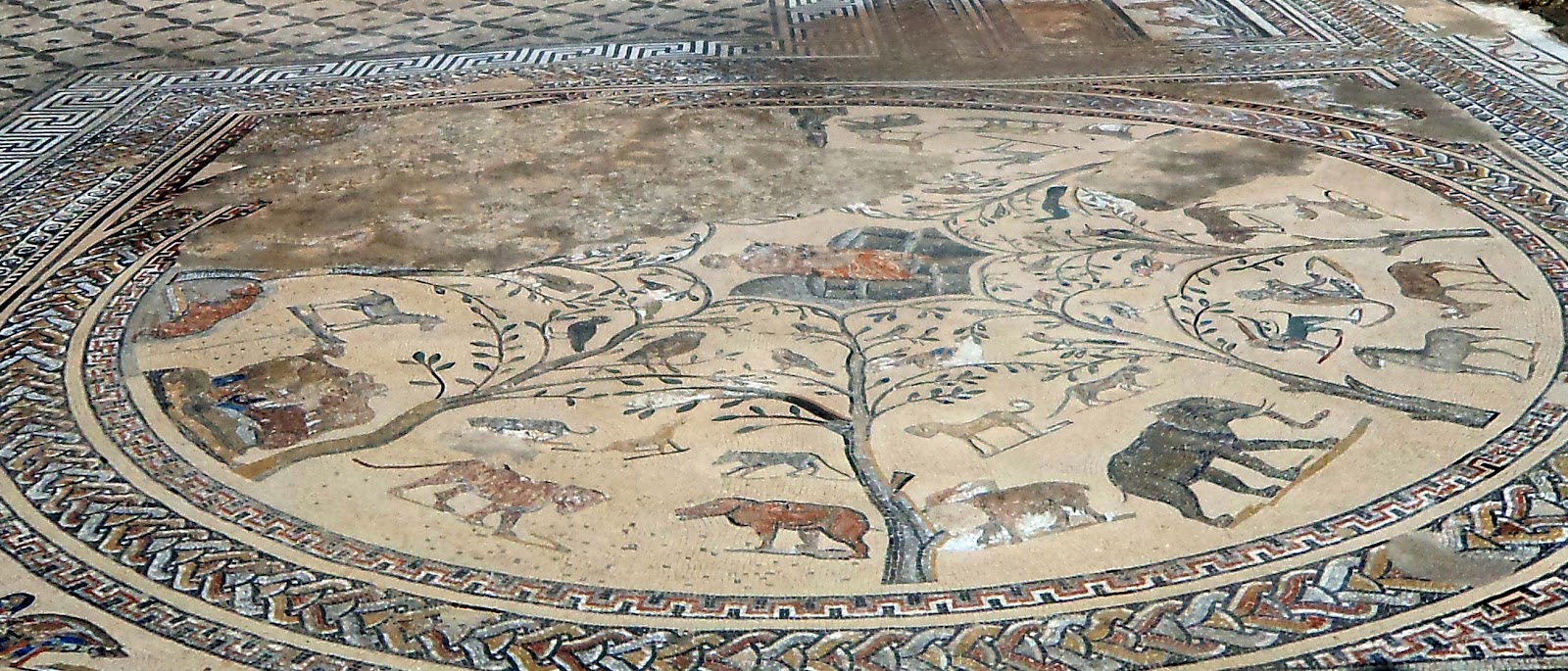
Volubilis may not quite make it with Herculaneum or Pompeii but it is up there knocking at their door. It has most impressive well preseved mosaics. Everywhere else I've been they've removed the mosaics off to modern musems on site but in Volubilis they remain in situ so you can really appreciate what the house would have been like. 
The site is extensive with no shade so try and get there at 8 when it opens particularly in summer.We followed the route set out in the Rough Guide and found this quite adequate to get around. We used up all our water and were flagging by the end as to see everything took about  21/2 hours
.Although there was a Punic settlement here in the 3C BCE the remains seen today are of the Roman Town of the 2-3C CE. The romans withdrew in 285 CE. Volubilis was the chief source of lions for games and they were hunted to such an extent that they became extinct in the region within two centuries. The city remained active however until the 18C when its marble was takenand it economy resited to build Moulay Ismail's Meknes.
The tour route starts with some restored olive presses and smaller houses and then the first blockbuster is the House of Orpheus which has a private inner courtyard with dolphin mosaics, and then the public atrium with the impressive Chariot of Amphitrite Drawn by a Seahorse mosaic, and the eponymous Orpheus mosaic. There is also a complex system of baths with heating which is somewhat surprising as the house was very close to the public baths.


Dolphin mosaic in the House of Orpheus, Volubilis


Bath, House of Orpheus, Volubilis


Restored olive press, Volubilis


Restored olive press, Volubilis


Orpheus Mosaic, House of Orpheus, Volubilis


Corner detail, Orpheus Mosaic, House of Orpheus, Volubilis.


Chariot of Amphitrite Drawn by a Seahorse, House of Orpheus, Volubilis 


Monday, 6 August 2012

Storks at Volubilis


I have never managed to get a picture of the storks in Taroudant. When I have my camera they are not there; when they are there - no camera. May seems to be a good time for them because they have young in their nests and they are feeding them. We saw them in Taroundant, Meknes, Moulay Idriss and most of the villages of the Middle Atlas but the most spectacular nests were those on top of the roman columns of Volubilis.